

 en
en  Italian
 French
 German
 Spanish
 Portuguese




- 15/07/2026
- Economy and marketing
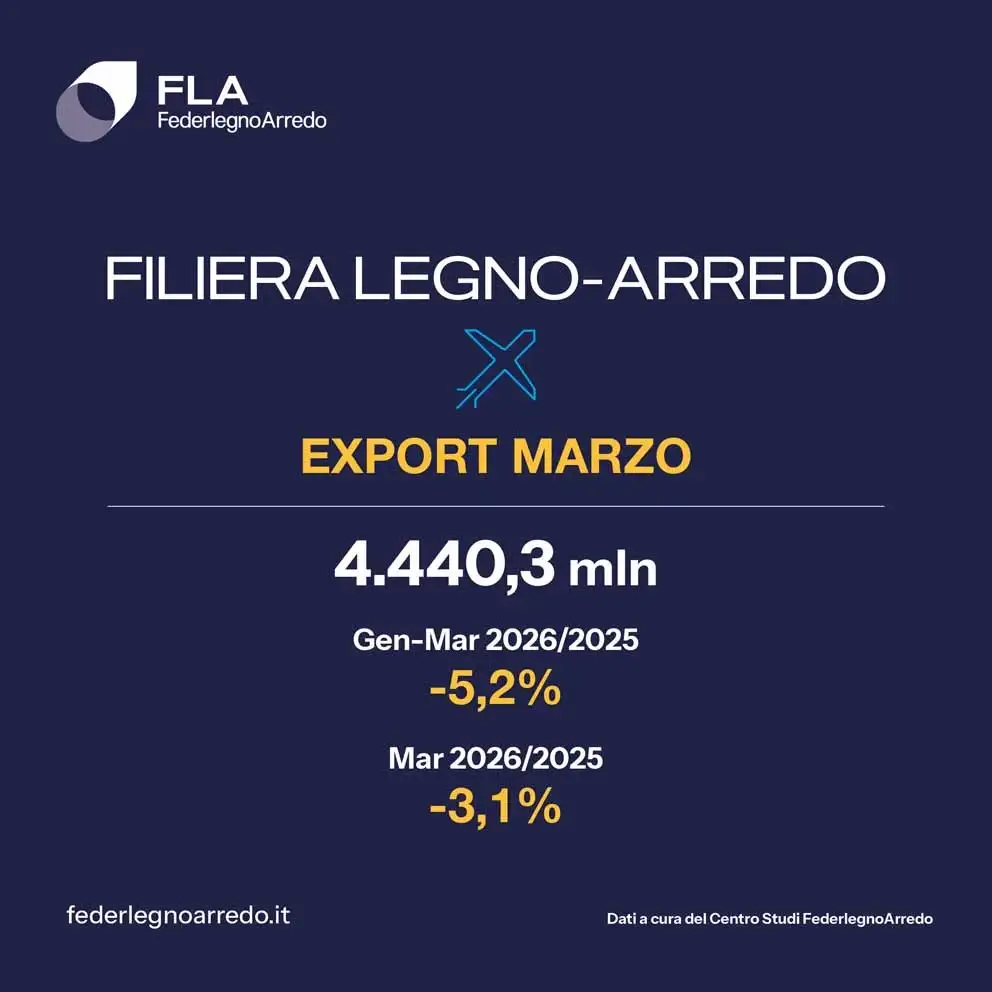
Data on the exports of the wood-furniture supply chain in the first quarter of 2026 confirm the slowdown already seen in previous months, recording a 5.2% decline. In March 2026, according to data processed by the Research Center of FederlegnoArredo based on Istat data, the decrease stood at 3.1% in an international context characterized by rising geopolitical tensions.
Negative signals from the United States, Germany and France
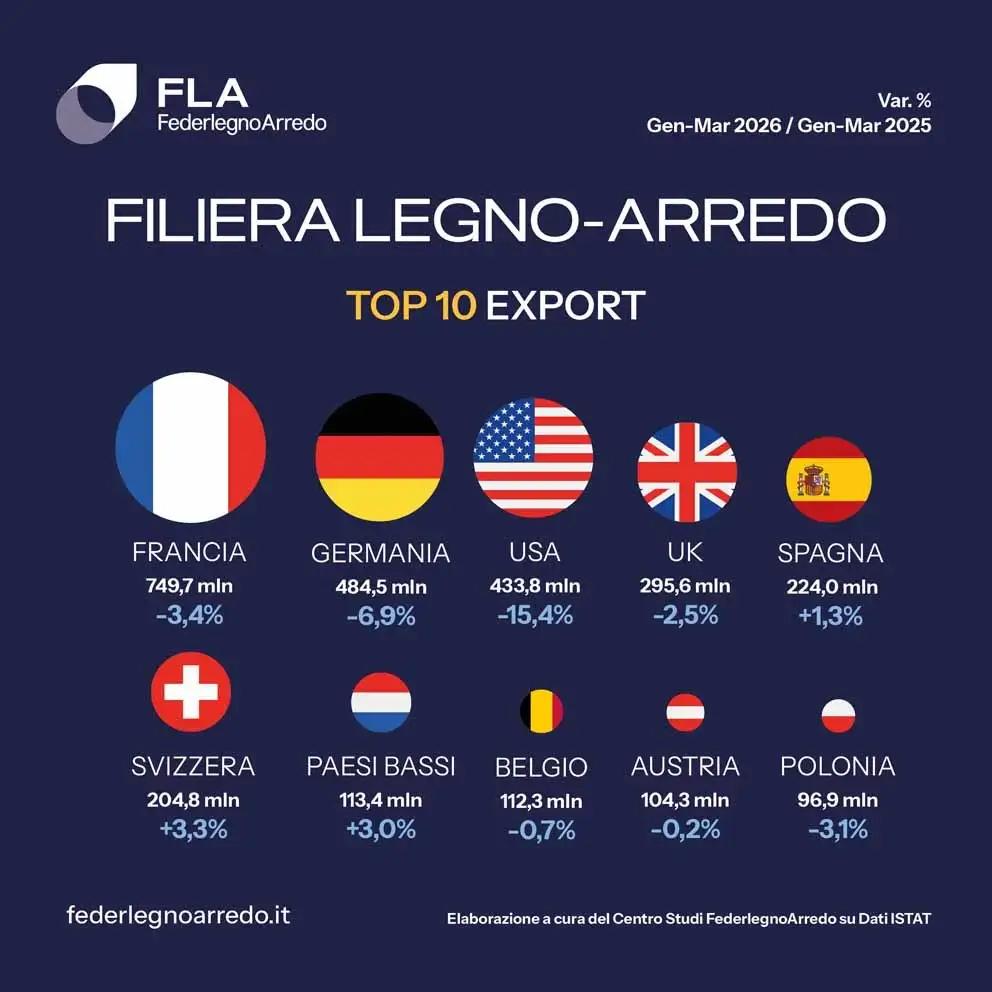
The market with the largest absolute loss is undoubtedly the United States with a contraction of 15.4%. Also negative are the main European partners of the supply chain Germany (-6.9%) and France (-3.4%), while positive signs come from Spain (+1.3%), Switzerland (+3.3%), the Netherlands (+3%) even if the growth mainly concerns smaller markets
“The sharp slowdown in the United States, together with the difficulties of Germany and France, is sapping momentum from our main reference markets.” - explains Claudio Feltrin, president of FederlegnoArredo. “Added to this is the impact of the conflict in the Middle East, a strategic area that, in the first quarter, recorded a contraction in exports of 23.4%. The first signs of recovery recorded in April in OPEC countries are fairly encouraging, but the picture remains fragile and uncertain.”
Collapse of exports to the Middle East
The impact of the conflict in Iran was felt more intensely in March and consequently exports to the area plunged by as much as 48.8%. The falls recorded in the United Arab Emirates (-78.5%) and Saudi Arabia (-57.3%) were extremely heavy.
Some tentative signs of recovery for the furniture sector can be seen from April when exports to OPEC countries moved from -66% in March to -27%
Alarm over imports from China
Another phenomenon to closely monitor concerns imports and in particular furniture imports from China, which grew by 19.6% in April alone.
“In the year-to-date - said Feltrin - the figure remains negative (-6.6%), but solely as a result of the peaks reached in 2025. The increase in incoming products, while the export of our products slows, represents a particular concern for the competitiveness of the national industry and for the balances of the domestic market. Therefore, fair competitive conditions must be guaranteed and it is essential to continue investing in quality, sustainability and innovation that make our Made in Italy unique, through strengthening instruments for internationalization that facilitate the opening of new commercial outlets.”
It is necessary that Europe puts in place all the measures needed to defend the domestic market, enforcing the rules also on those who produce outside European borders.
Furniture revenue down, wood industry stable
According to FederlegnoArredo data, the furniture sector continues to be affected by international weakness. In the first quarter industry revenue recorded a 3.5% decline, driven mainly by the fall in exports (-7.5%). Imports remain negative in the January-March cumulative (-6%), but show a progressive recovery month by month up to an acceleration in April with +11.2%.
The situation of the wood industry is more stable, closing the quarter with a revenue essentially unchanged (+0.2%). The trend in producer prices (+3.7% in the January-April period) partly offsets the contraction in production volumes (-5.6%), in a context characterized by strong tensions on raw materials, in particular on sawn timber, which are recording price increases of over 9%.