 en
en  Italian
 French
 German
 Spanish
 Portuguese



- 19/06/2026
- Economy, News and Fairs
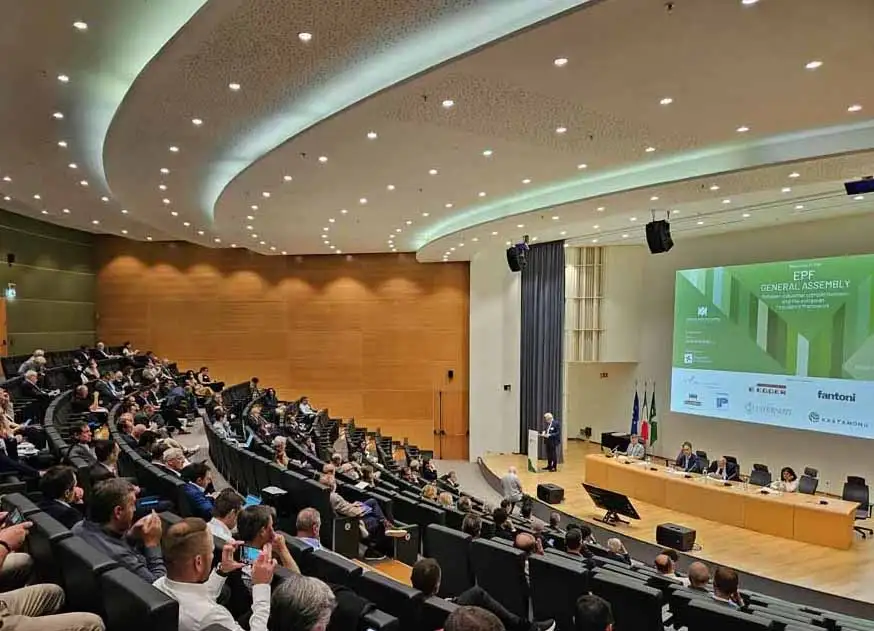
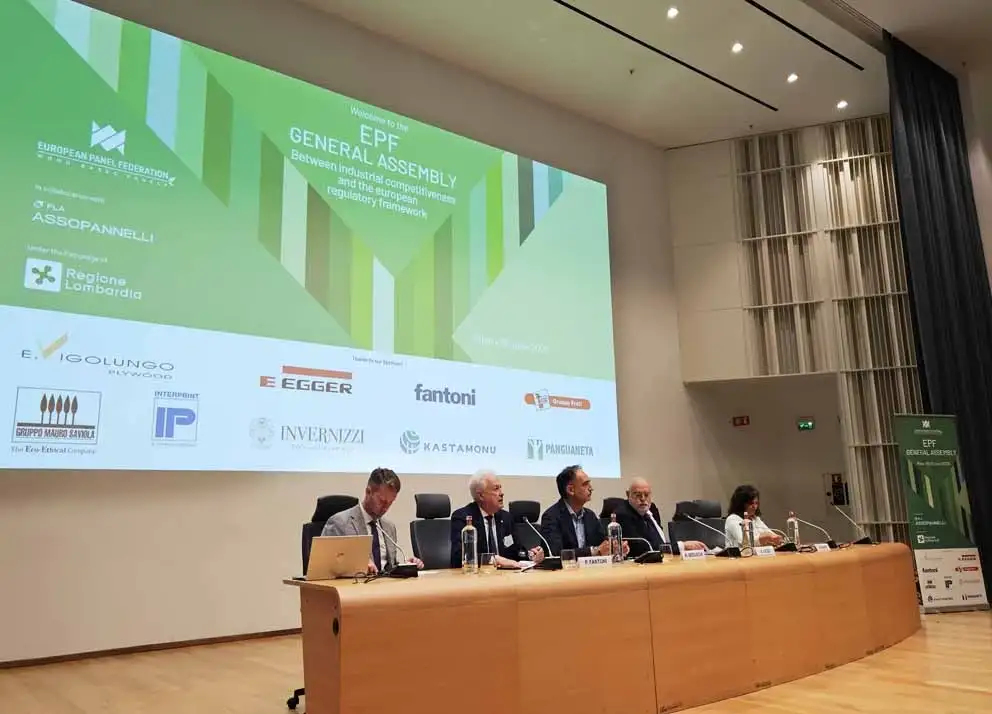
"The panel industry, between Industrial Competitiveness and the European Regulatory Framework" was the theme of the conference organized by FederlegnoArredo and Assopannelli, within the EPF (European Panel Federation) General Assembly. Sponsored by the Lombardy Region, the event, held on 12 June in Milan, brought together representatives from European and national institutions, associations and the supply chain to address the challenges facing the sector: from the energy transition to the Carbon Border Adjustment Mechanism (CBAM), and market outlooks.
Panels: a strategic component of the wood-furnishing supply chain
The panels represent a strategic component of the wood-furnishing supply chain and a concrete example of the circular economy. They are in fact mostly manufactured through the recovery and recycling of wood, contributing significantly to the sector's sustainability.
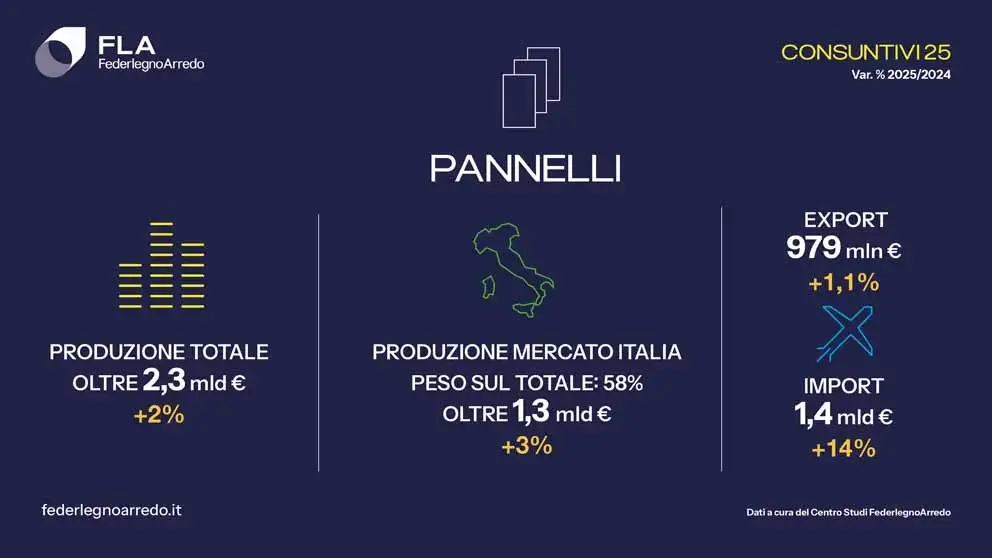
According to the final data presented during the conference, in 2025 the sector exceeded a value of €2.3 billion, up 2% compared to the previous year. Production destined for the Italian market, which accounts for 58% of the total, recorded a 3% increase, surpassing €1.3 billion. Exports, amounting to €979 million, grew by 1.1%, with varying trends across segments; imports also increased, rising 14% to reach €1.4 billion.
Turning the tide
Among the speakers, Paolo Fantoni, President of Assopannelli of FederlegnoArredo, outlined the context in which the panel industry operates today: “The sector faces persistent consumption stagnation, reduced profitability, high energy costs and growing competition, with China increasingly asserting itself as a direct and indirect competitor. We must reverse this trend. We ask Europe for policies consistent with the goal of strengthening the continent's industrial base and enhancing companies' investments. Along these lines are our requests regarding specific instruments such as CBAM, a regulation that results in increased costs for our products, in an already complex geopolitical context”.
Remember that CBAM, the Carbon Border Adjustment Mechanism, is an EU measure that imposes a charge on emissions for products imported from non-EU countries, effective as of 1 January 2026.
On the role of EU legislation – from CBAM to the broader geopolitical context – MEP Massimiliano Salini, member of the Committee on the Environment, Public Health and Food Safety (ENVI), intervened: “The European Union's dependence on certain raw materials has a direct impact on the European market. In an extremely unstable geopolitical context, characterized by uncertain energy prices and supply security, the EU needs to find a balance between environmental sustainability and an economic impetus adequate for our industries”.
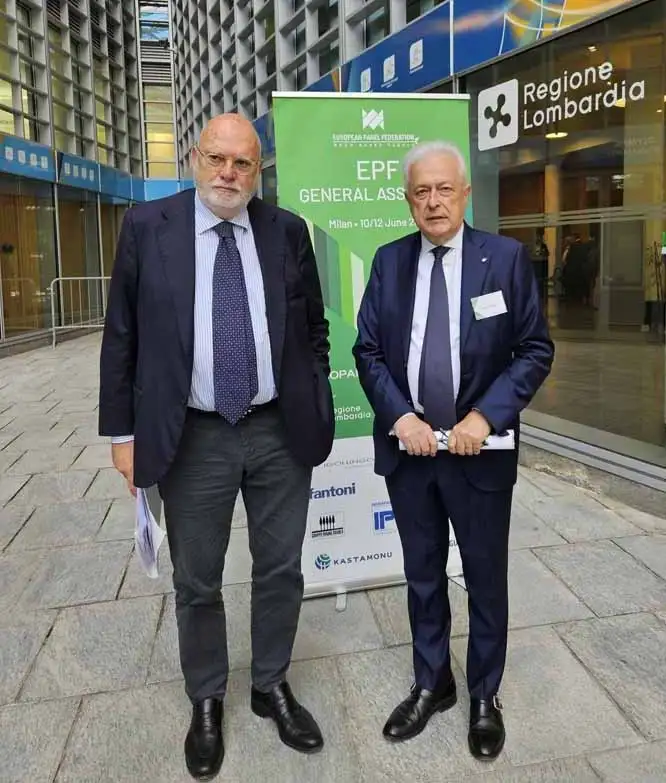
Antonio Gozzi and Paolo Fantoni
Industrial competitiveness at the center of European policies
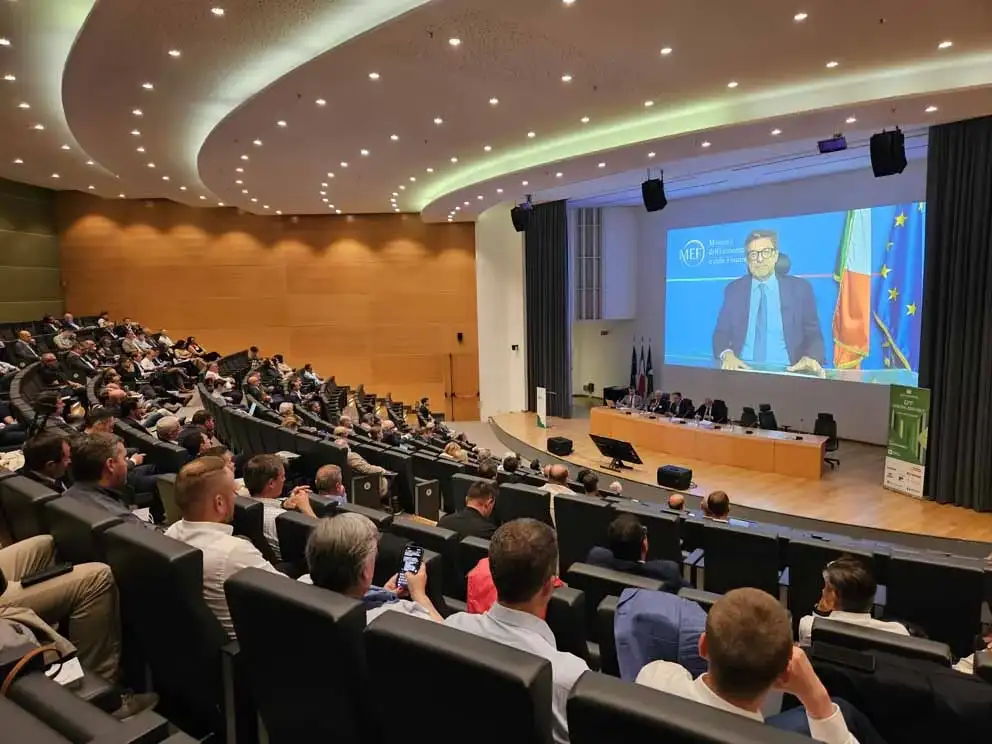
With a video message, the Minister of Economy and Finance, Giancarlo Giorgetti, reiterated the Italian Government's commitment to European industrial competitiveness. In this regard he stated that European industry today faces clear and growing challenges and therefore the response must be equally clear: businesses must be supported with pragmatic and realistic policies, aware that when global demand weakens, the single market can and must be part of the answer.
Emphasizing the absolute centrality of these challenges was also Antonio Gozzi, President of Federacciai and Confindustria's delegate for European strategic autonomy, the Mattei Plan and Competitiveness, arguing that “today the priority must be to bring industrial competitiveness back to the center of European policies, simplifying rules and supporting investments. The ecological transition remains a fundamental objective, but it must also be sustainable from an economic and production standpoint”.
Sustainability: a competitive advantage for European producers
At the conclusion of the proceedings the EPF President, Pablo Figueroa López, emphasized how "The data from the Economic Outlook 2025 confirm a sector under strong pressure, but also its resilience. Projects like EcoReFibre demonstrate that the future of our industry is circular by definition: transforming recovered wood fibres into new high-quality panels. It is exactly here that European competitiveness and the Union's climate objectives meet. What we ask of policymakers is a regulatory framework that rewards these investments rather than penalizing them, so that sustainability becomes a competitive advantage for European producers and not a cost shifted onto importers".