 en
en  Italian
 French
 German
 Spanish
 Portuguese


- 24/11/2025
- Economy, News and Fairs
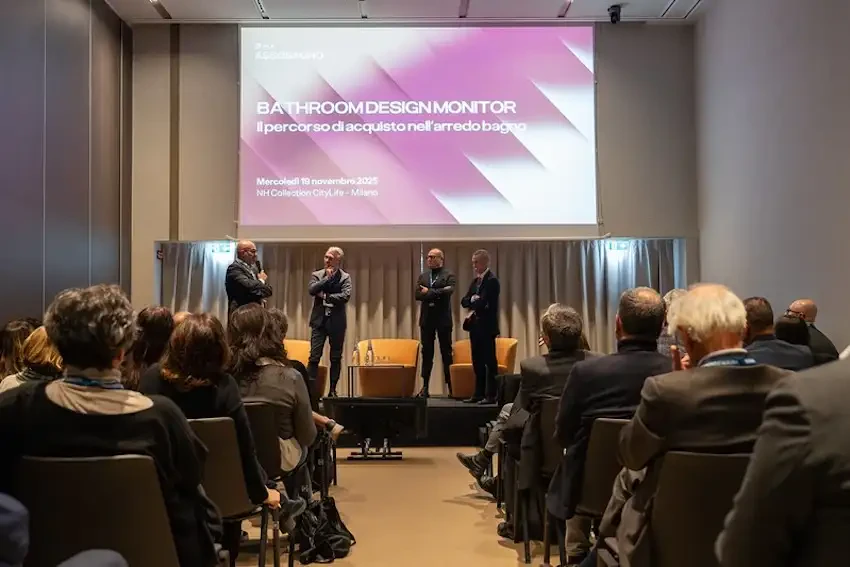
"Bathroom Design Monitor 2025", the research carried out by NIQ-GfK Italia for Assobagno of FederlegnoArredo, was created to offer operators concrete tools to interpret the evolution of purchasing behaviors. Presented last Thursday during a day organized by Assobagno, the research results highlighted how the bathroom is now considered increasingly the central space of the home and of personal well-being, and how the bathroom retailer remains the absolute protagonist even though online purchases are growing.
Bathroom, center of domestic well-being
The research involved three thousand consumers in Italy, France and Germany, all engaged in a recent bathroom renovation or intending to carry one out in the next 18 months.
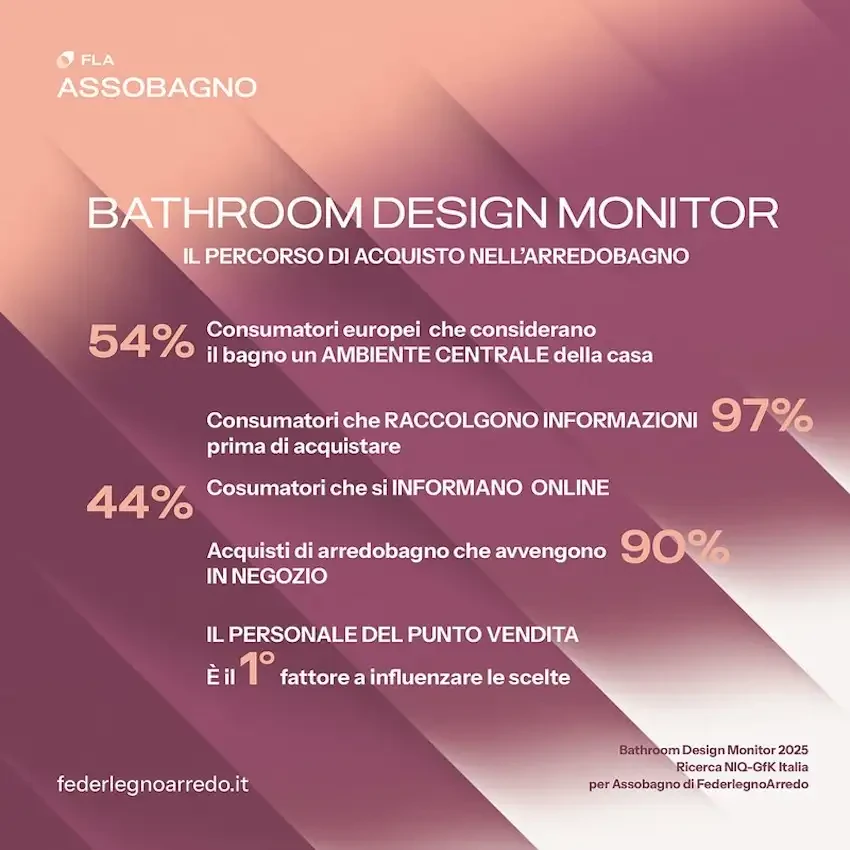
More than half of respondents − 54% at the European level and 57% in Italy − consider the bathroom the center of domestic well-being. The bathroom retailer remains central: 90% of purchases still take place at the point of sale, where staff expertise is essential for the final decision. At the same time, the share of consumers integrating physical and digital channels is growing: a demanding audience that represents a great opportunity for companies able to best integrate the physical and digital worlds.
Elia Vismara, President of Assobagno of FederlegnoArredo, explained: "The research 'Bathroom Design Monitor 2025' shows a more informed and aware consumer, who moves naturally between physical and digital. The point of sale remains an essential reference, but the decision begins much earlier, online. For companies and distribution this means ensuring consistency, competence and service throughout the entire journey."
An informed consumer across multiple channels
The research also reveals how the purchase of bathroom furnishings is a careful process, which often involves integrating multiple channels (both physical and digital) when gathering information and finalizing the purchase.
97% of European consumers seek information before buying and 44% do so online. The main tools used are search engines (64%), retailers' sites and apps (58%) and manufacturers' sites and apps (48%). In Italy the role of architects and designers (28%) and trade magazines (29%) stands out, while in Germany online is even more decisive (49%).
The share of consumers who, in their last renovation, bought both in-store and online is nevertheless very significant - 41% in Europe, 37% in Italy, 50% in Germany.
E‑commerce is growing (21% purchased online, 41% will do so), but it only partially converts intentions, confirming the solidity and value of the point of sale. Consumers look for functionality and durability, with great attention to the longevity of the investment. Design and build quality complete the picture, key elements in product choice.
Bathroom furnishings, a healthy System
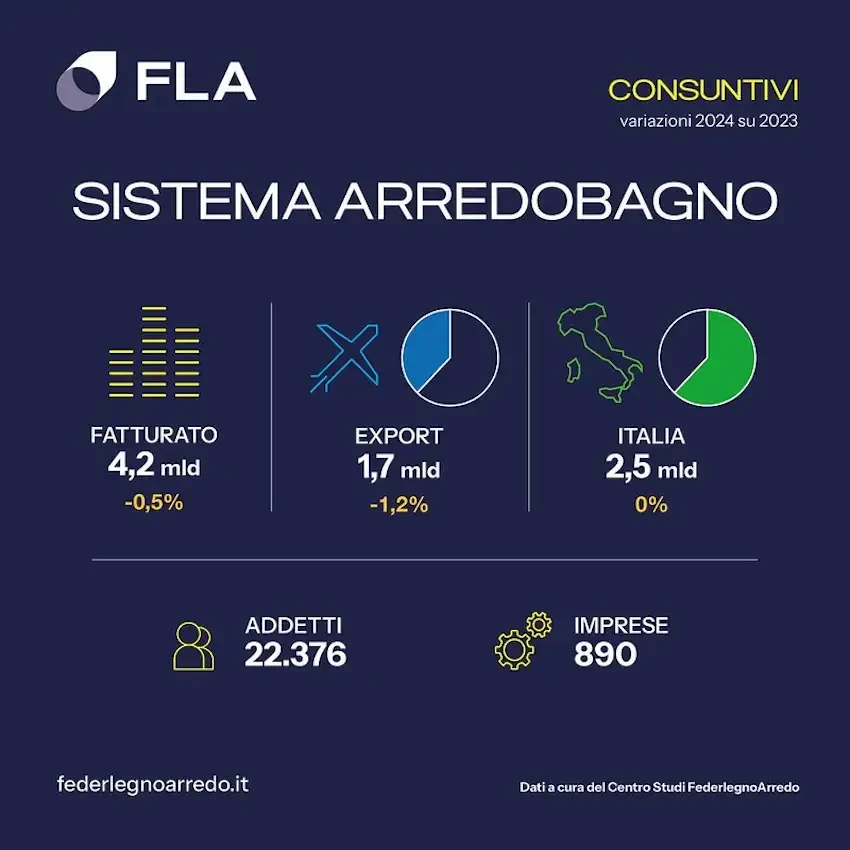
According to the final reports of the FederlegnoArredo Study Center, the production turnover of the Bathroom Furnishing System stands at around €4.2 billion. France and Germany confirm themselves as the main foreign markets, each with about €260 million in value, equal to more than 15% of exports. The domestic market, stable, represents 60% of the total. In this context, the extension of building and furniture tax incentives until 2026 encourages investment in the bathroom and facilitates access to quality Made in Italy products.