 en
en  Italian
 French
 German
 Spanish
 Portuguese



- 25/09/2026
- Economy, News and Fairs
The persistence of geopolitical tensions, wars that do not seem to find short-term solutions and the instability of certain areas of reference for Made in Italy are putting our companies in difficulty, slowing especially exports of the wood-furnishing sector.
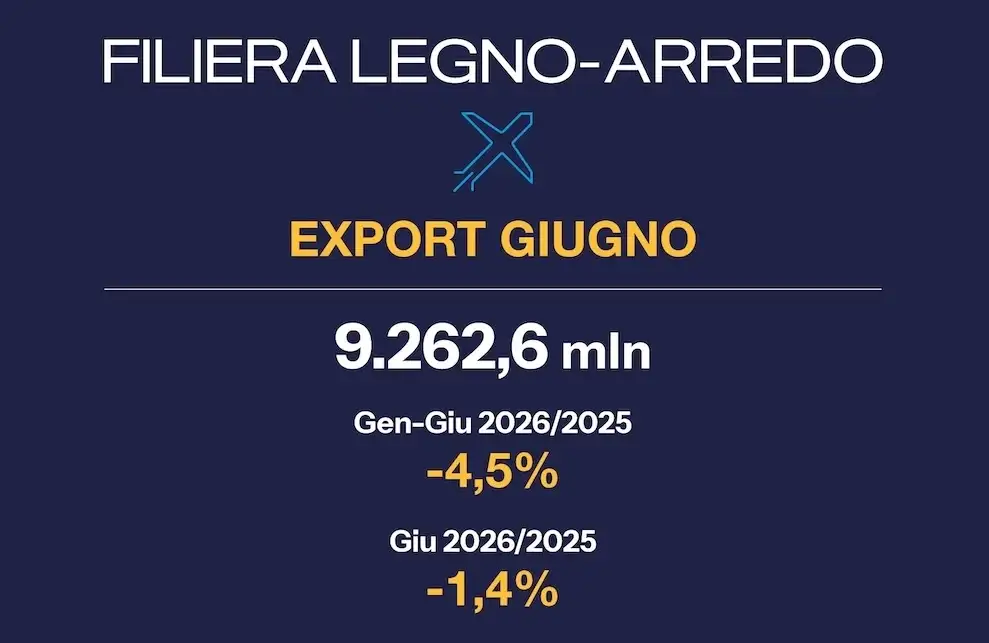
The export data, compiled by the FederlegnoArredo Study Center, using Istat data, are not positive: after the slowdown in May (-10.1%), in June the’wood-furnishing export recorded a decrease of 1.4% compared with June 2025, and in the first six months of 2026 the decline was 4.5% with a value of 9.2 billion euros. The domestic market remains flat (-0.7%), at least for the furniture sector.
Preserving the international competitiveness of the supply chain
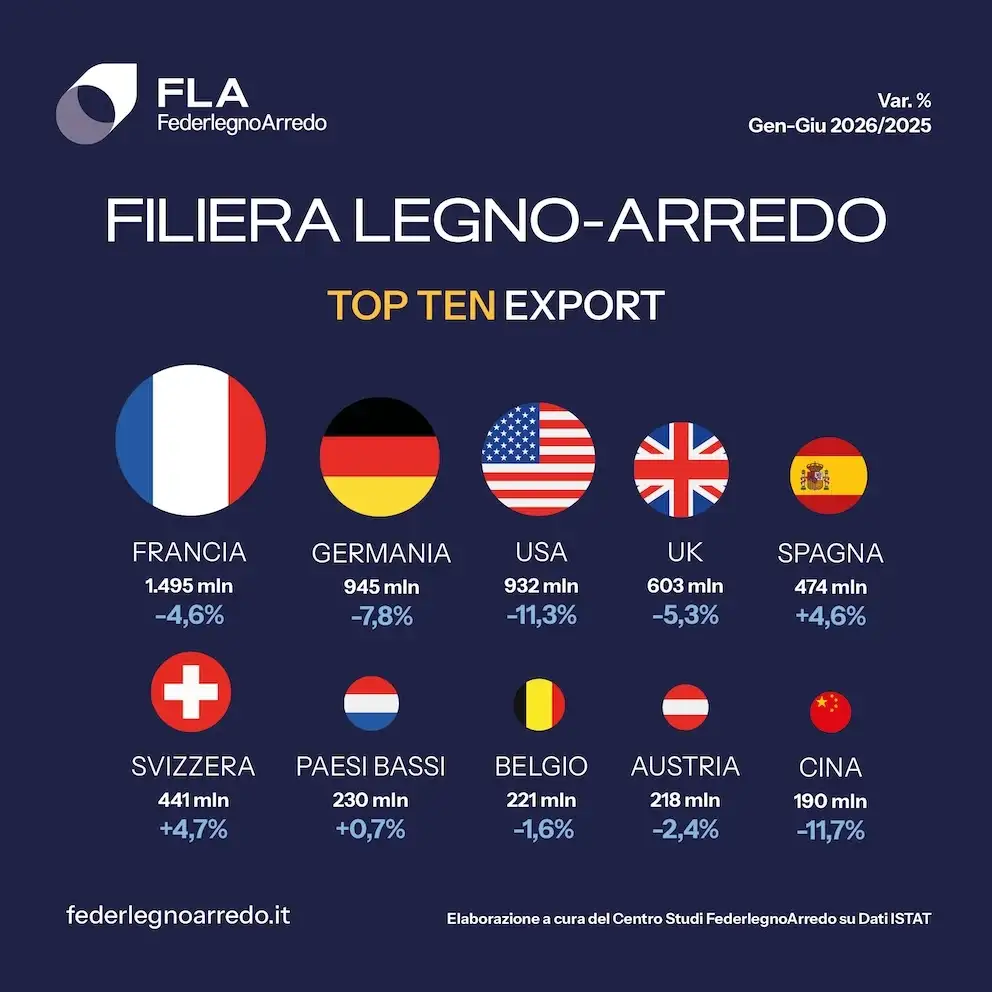
Among the main countries with negative performances we find the top four destinations of Italian wood-furnishing exports: the United States with -11.3% fall from second to third place in the Top Ten; France remains in first place but records -4.6% and Germany is second with -7.8%; the United Kingdom is fourth with -5.3%. The United Arab Emirates at -15.2% even fall out of the Top Ten.
“It will be essential - explains Claudio Feltrin, president of FederlegnoArredo, - to continue supporting the internationalization processes and strengthen the presence of our companies in foreign markets. The objective remains to preserve the international competitiveness of the supply chain also through European energy policies that protect production.”
Furniture Exports: down 5.7% in the first seven months
Analyzing in particular the furniture exports, in the first seven months of 2026 they amount to 6.38 billion euros, registering a decline of 5.7% compared with the same period of the previous year. This figure reflects the difficulties that the sector must face in many strategic markets, a consequence of the difficult international situation.
Germany records a decline of 10.5%, the United Kingdom falls by 7.1% and France by 5% Even stronger is the contraction in the United States (-12.9%) and in China (-17.7%), which continues to suffer from difficulties in its economic cycle.
Spain (+2.7%) and Switzerland (+5.5%) are the only positive signs: overall, EU countries close at -4.3%.
Some positive signs in July
The month of July seems to indicate a slowdown in the contraction: although it records a decrease of 1.3% compared with the same month in 2025, it marks the best monthly result of the first seven months of the year.
Also in July the main markets remain weak: Germany and the United Kingdom both record a drop of 10.1%, France -1.9%. The United States, with -2.5%, show the smallest decline since the beginning of 2026.
“Alongside the difficulties of traditional markets, however, signs of dynamism are emerging from some destinations that are helping to mitigate the overall decline in furniture exports. In July - explains Feltrin - the performances of the Netherlands (+19.7%), Spain (+10.6%) and Switzerland (+4%) stand out, confirming how market diversification represents a fundamental strategic lever for the competitiveness of Italian companies.”
The United Arab Emirates recover, contributing to the growth of the OPEC area: in July they record +12.6%, although the year-to-date total remains negative (-13.1%). Still negative for China, which in July reaches -23.4%, bringing the year-to-date total for the first seven months to -17.7%.