en
 Italian
 French
 German
 Spanish
 Portuguese



- 29/10/2026
- Economy, News and Fairs
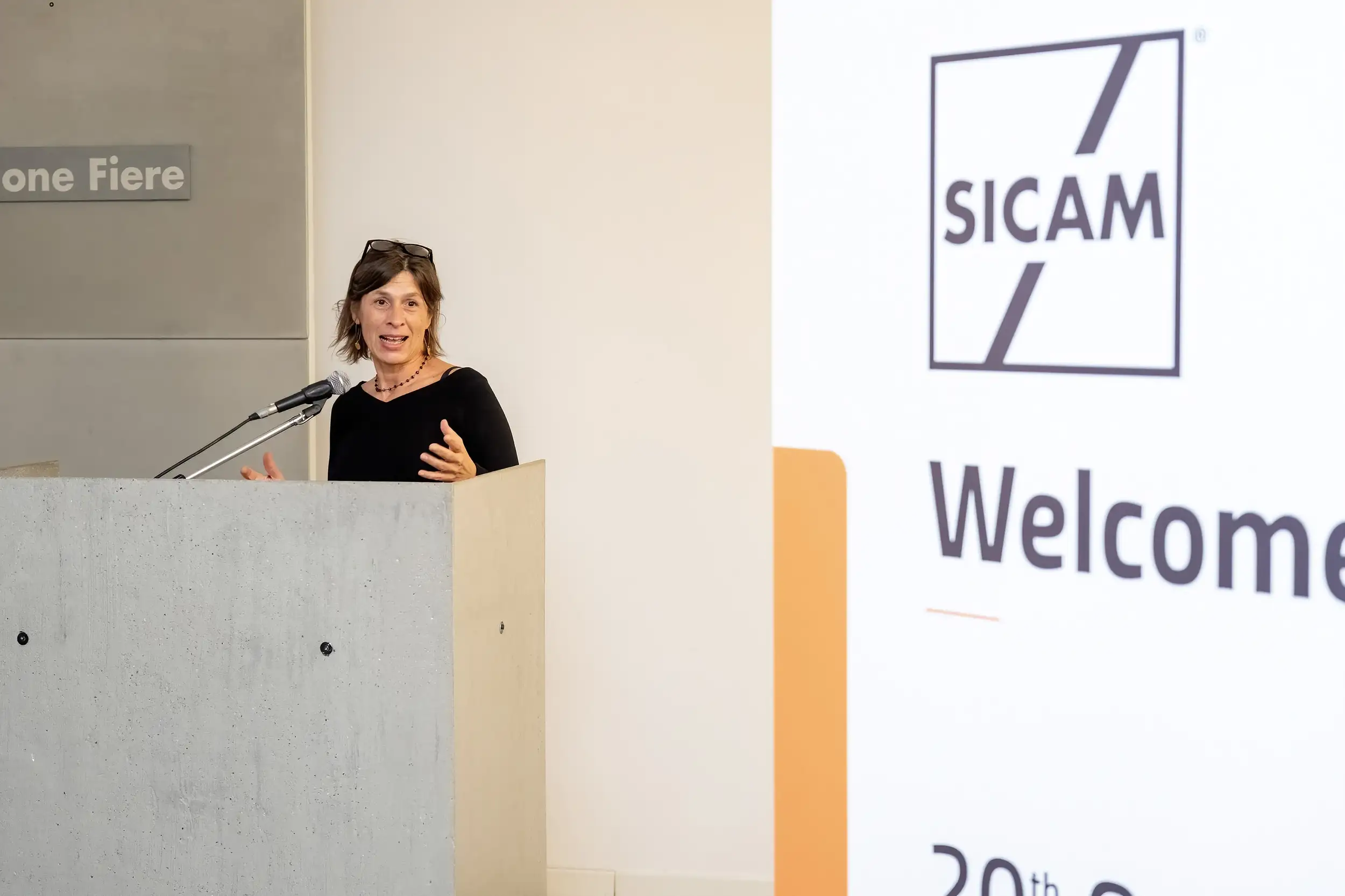
During the traditional opening press conference of SICAM 2026, Alessandra Tracogna (in the photo), Partner and Senior Expert at CSIL, presented an interesting study carried out for SICAM by the economic research institute entitled “Un osservatorio di lungo periodo sul settore della componentistica per il mobile in Italia e in Europa”.
The analysis, which covers a ten-year horizon, reveals how SICAM is a privileged observatory: the fair's exhibitors in fact constitute, from the first edition in 2009 to today, a qualified sample and a representative mirror of the main industrial realities of the Italian and European sector.
Components: 10 years of transformations
The study says a lot about the transformations of the furniture supply chain and components over this decade. Globalization has redesigned value chains, opening the way to new production hubs. The introduction of innovative materials has expanded design possibilities. Digitalization has changed processes, relationships along the supply chain and the way products reach the end consumer. Added to this is a growing focus on the environmental impact of products and processes, also due to the introduction of specific European regulations. End markets have also changed: traditional retail has transformed, online channels have grown and new needs related to the different home environments have emerged.
These changes clearly emerge from the CSIL survey which relied on various sources: company press releases and ten-year data on SICAM exhibitors, national and international statistical data, CSIL reports on the different furniture segments and data published by the trade press.
A European and local supply chain
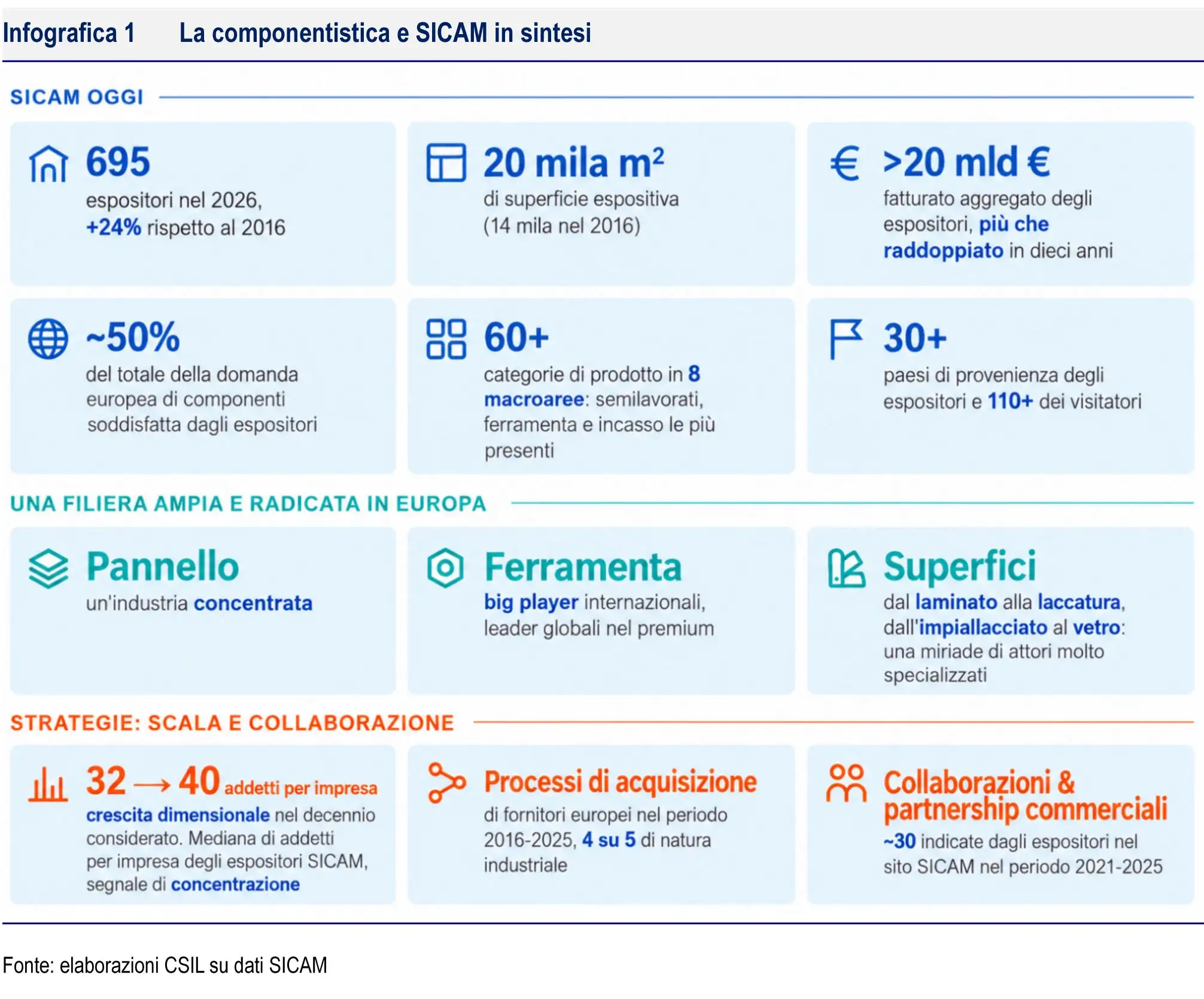
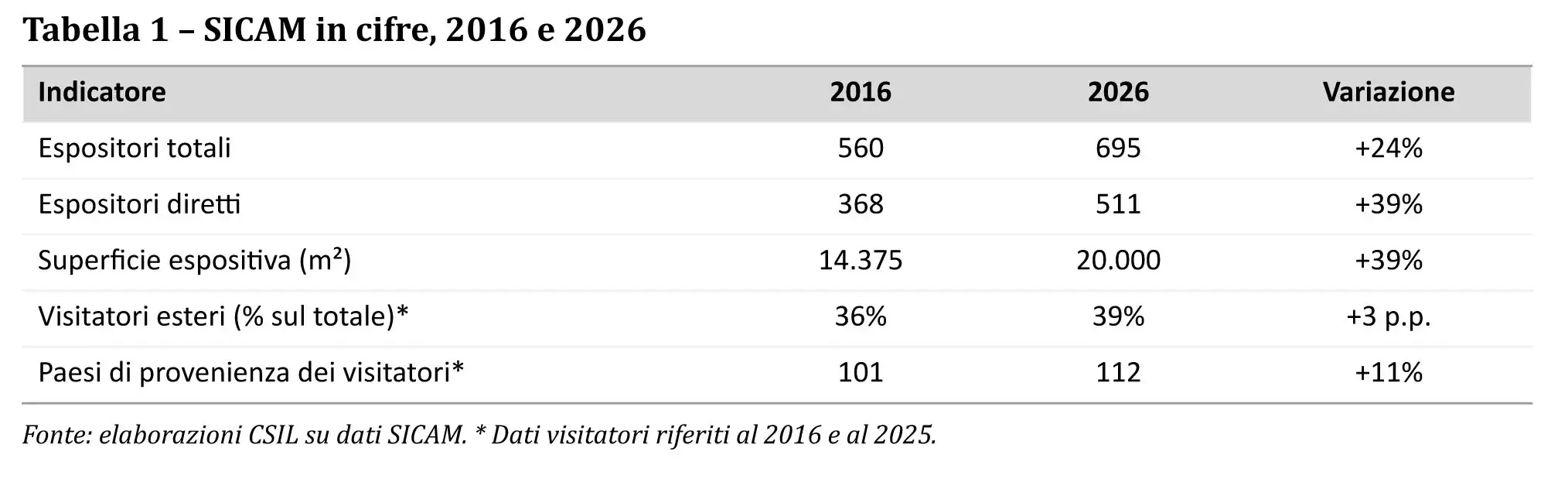
According to CSIL estimates, the exhibitors at the show together satisfy 50% of European demand for components for furniture, for an aggregate turnover of over 20 billion euros. Between 2016 and 2026 exhibitors grew by 24% (39% for direct exhibitors), exhibition space increased from about 14,000 to 20,000 sqm and the international dimension of the fair presence also grew.
The supply chain of components for furniture is still largely European: for particleboard and MDF panels, for example, the majority of consumption is met by European production. SICAM data confirm this: about 90% of exhibitors, over these ten years, are based in the EU. Italy represents about 70% of exhibitors, followed by Germany (8.9%) and Turkey, which rose from 3.5% to 5.2% and is today the third country by presence.
Italy also stands out for its furniture districts: SICAM is located in the Pordenone furniture and panels district, but there is also a strong presence from Brianza and Marche and growth from Emilia-Romagna and Piedmont.
Over 60 product categories
The components sector is broad and complex, capable of providing everything needed for the production of the European furniture industry. SICAM covers over 60 product categories, grouped by CSIL into eight macro-areas: from wood semi-finished products to hardware, from kitchen and built-in elements to panels, surfaces, chemicals and lighting.
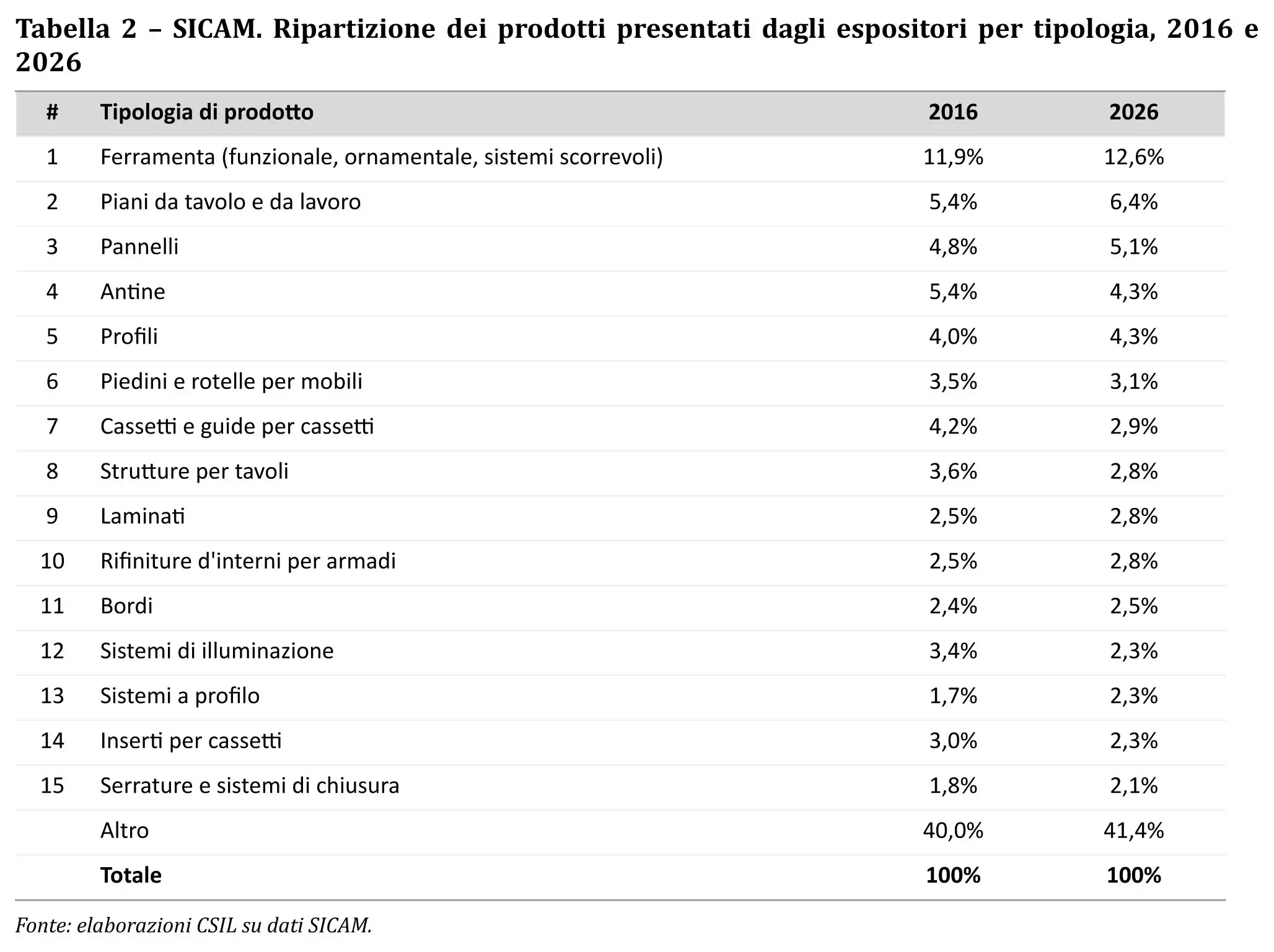
Table 2 shows the breakdown of products presented by exhibitors by type in the SICAM catalog in 2016 and 2026: from the comparison we can note growth in hardware, tops and panels, categories that play a central role in furniture production; the same applies to laminates and edgebands, related to the world of surfaces and finishes.
The furniture industry according to CSIL
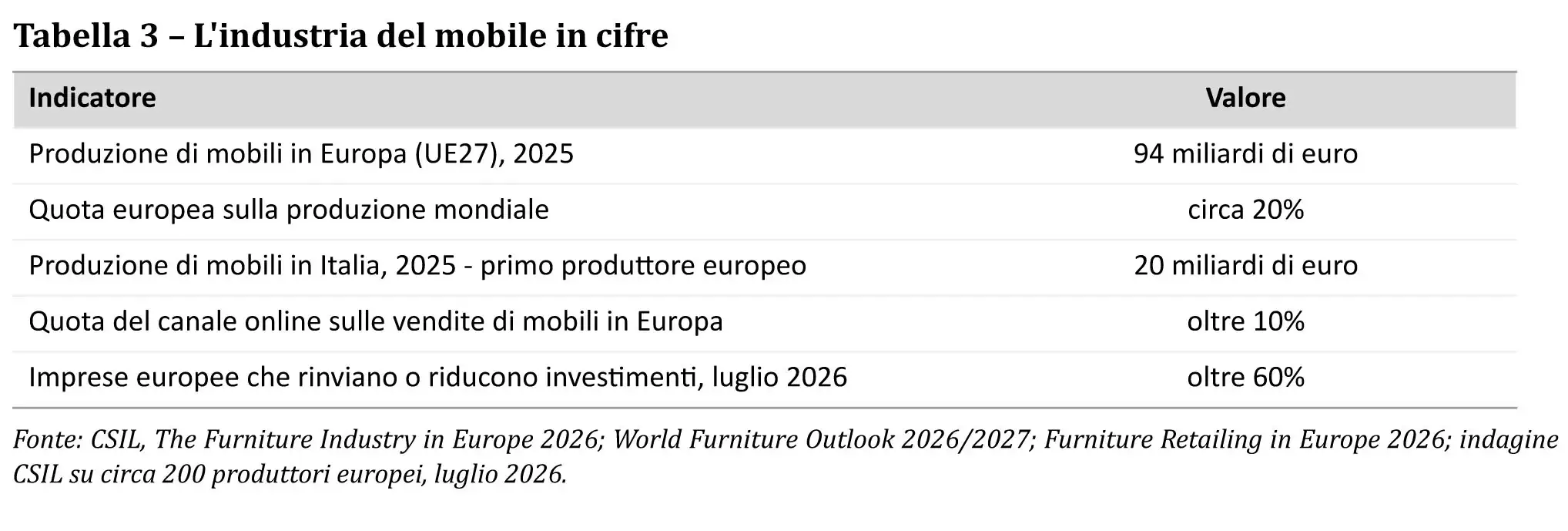
As shown in Table 3, the European furniture industry, the reference market for the components sector, is worth over 90 billion euros, with Italy in first place among producing countries, which maintains its share of world production in value at around 20%. This nominal resilience, moreover influenced in recent years by price dynamics, should not hide the pressures on the industrial base. Weak consumer demand, high production costs and the growing penetration of non-EU imports are putting pressure on furniture manufacturers and, by extension, their suppliers.
In this context, furniture companies are postponing mainly investments related to plants, hiring and training, but not those related to innovation: less than 15% of producers interviewed by CSIL intend to reduce or postpone investments in product innovation. In fact, faced with non-EU competition, European furniture focuses above all on design, quality, customization and regulatory compliance.
Suppliers between challenges and opportunities
A very interesting part of the CSIL study concerns precisely how SICAM exhibitors, who are in fact the suppliers of the furniture industry, respond to the needs of manufacturers, architects and designers, and craftsmen.
These are the main topics addressed by the companies, which we also observed this year at the various stands of the event.
Aesthetics and functionality. According to CSIL's analysis of product descriptions published in SICAM's “Exhibitors' Showcase” in 2021–2025, surfaces are the most relevant theme: super-matte and soft-touch finishes combined with anti-fingerprint properties and durability, large-format stone effects, three-dimensional and tactile surfaces are among the most recurring solutions in this area.
Technology in furniture. Technological solutions are increasingly integrated into furniture: examples include integrated LED lighting, concealed sockets and charging systems, motorized movements and digital tools for design and traceability.
Sustainability. It is the theme that grows the most, from 5.7% to 10.1% of mentions between 2021 and 2025. In light of the evolution of European ecodesign regulation (ESPR) and the digital product passport, aspects such as durability, reparability, recycled content and availability of information on materials—areas in which components play a fundamental role—are becoming increasingly important.
From supplier to partner. The share of exhibitors mentioning collaborations and co-design activities with furniture manufacturers in the “Exhibitors' Showcase” and “News” sections of the SICAM website is increasing: from 2–6% in 2021–2023 it rose to 9% in 2024–2025.
A CSIL analysis also identified about 30 partnerships between suppliers, presented on the SICAM site in 2021–2025.
Sustainability, material innovation and digitalization
What are the prospects for the European components sector? In the last decade the sector has demonstrated a remarkable capacity to hold up. Sustainability, material innovation and digitalization will guide development in the coming years: they will entail adaptation costs, but will also offer opportunities for those who can innovate together with furniture manufacturers.