
 en
en  Italian
 French
 German
 Spanish
 Portuguese



- 01/06/2026
- Economy, News and Fairs
A slowdown in global demand, competitive pressure from China, rising raw material and energy costs and strong geopolitical instability: these are the issues addressed during the Annual Assembly of FederlegnoArredo.
which was held on Thursday, May 28 at the ADI Design Museum in Milan.
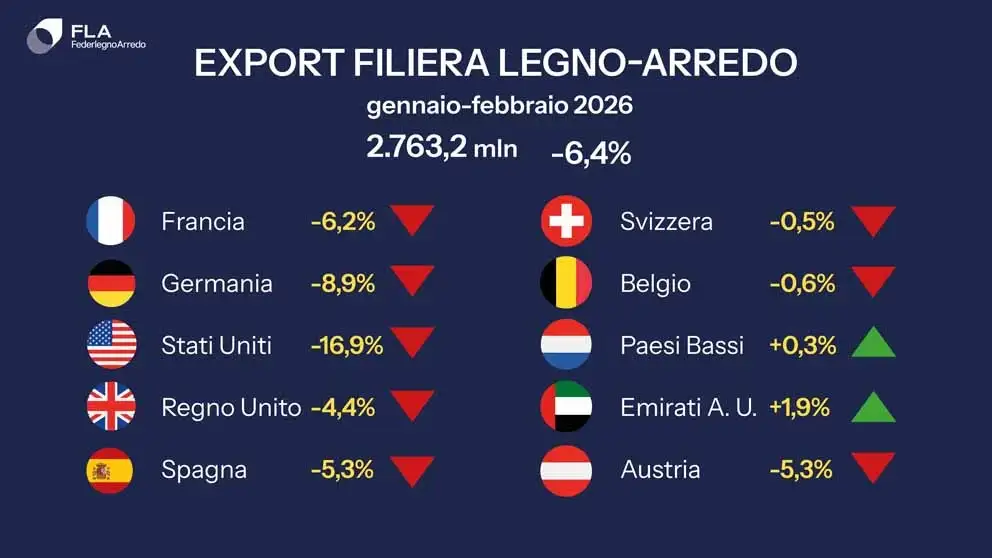
According to data from the FederlegnoArredo Study Center, in the first two months of 2026 the exports of the wood-furniture supply chain, a strategic supply chain for Italian manufacturing, amount to 2.76 billion euros, marking a 6.4% decline compared to the same period in 2025.
"The first months of the year - stated the president of FederlegnoArredo, Claudio Feltrin - confirm a situation of great difficulty on the international markets, while the domestic market shows signs of stability, albeit the summary of diversified trends".
Slowdown of exports in the first two months
What is slowing exports is mainly the performance of the main international markets: leading are France (469.6 million, -6.2%) and Germany (311.2 million, -8.9%), while a particularly marked contraction is recorded in the United States (-16.9%), the third destination market. Declines are also seen in the United Kingdom (-4.4%) and Spain (-5.3%), while Switzerland (-0.5%) and Belgium (-0.6%) are more stable. Among the few positive signs, a slight increase in the Netherlands (+0.3%) and in the United Arab Emirates (+1.9%).
Europe holds, the USA and OPEC area collapse
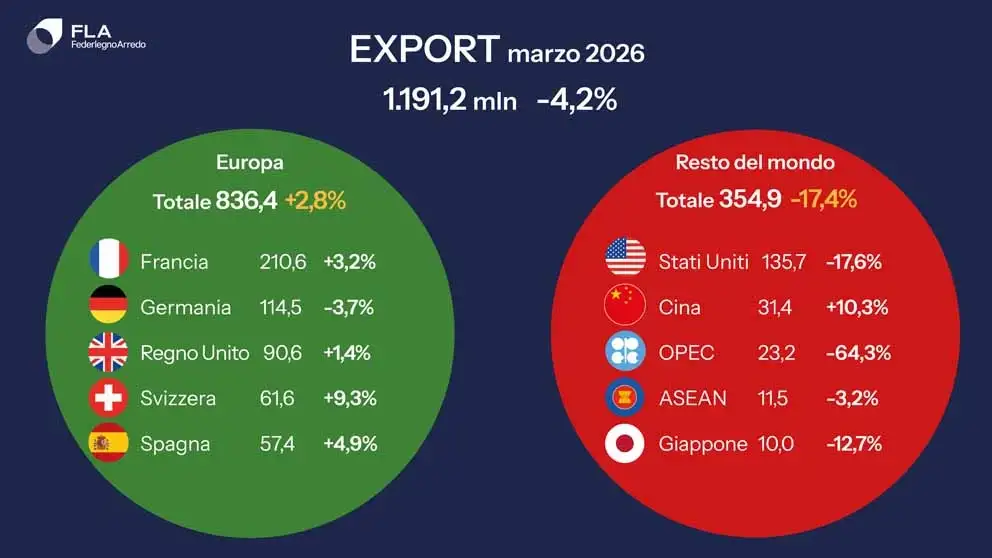
In March a partial change of scenario was observed with Europe appearing to hold, while the rest of the world collapses: exports reached 1.19 billion euros (-4.2%), with divergent trends between geographic areas. While the European markets show signs of resilience with growth of +2.8% thanks mainly to performances in France (+3.2%), Spain (+4.9%) Austria (+20.1%) and the Netherlands (+12.9%), there is a strong slowdown in the non-European markets, with an overall decline of -17.4%. The data for the United States is particularly negative (-17.6%), the leading non-EU market, and the drastic reduction in the OPEC area (-64.3%), due to the ongoing war.
Growing imbalance with China
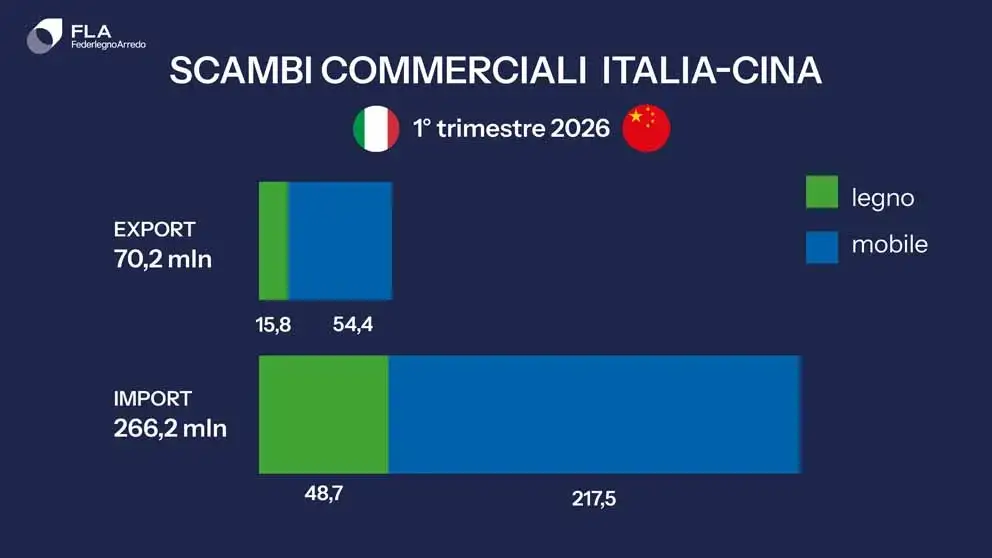
As Feltrin explains, “in this chessboard China exerts its full weight within international balances”. The data are very clear: in the first quarter of the year, Italy exported furniture and wood products worth 70.2 million euros, compared to imports almost four times higher, amounting to 266.2 million. This imbalance is particularly evident in the furniture sector, where imports (217.5 million) far exceed exports (54.4 million), with a growing competitive pressure on the domestic market.
Guaranteeing fair competition rules
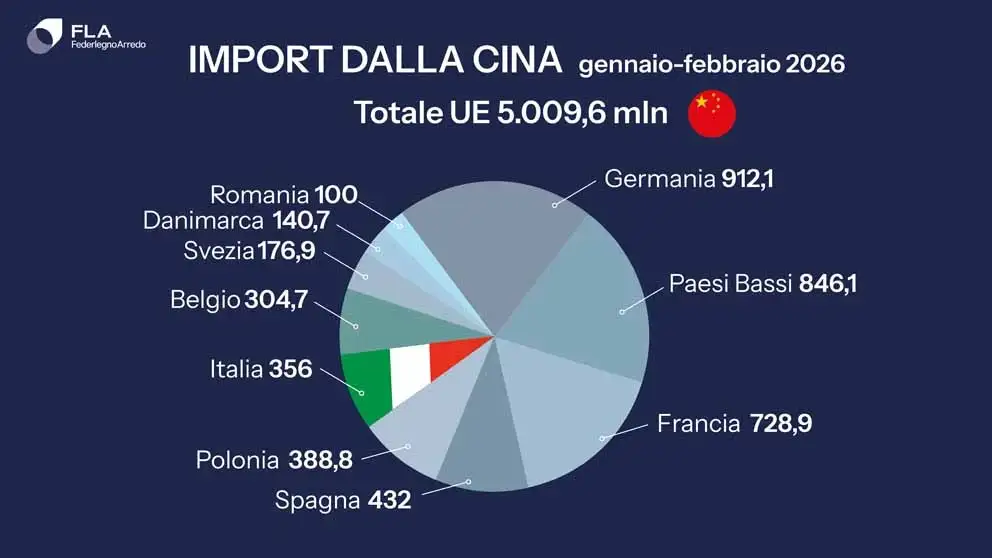
This phenomenon concerns not only Italy, but the entire European market: in the first two months of 2026, the European Union imported over 5 billion euros of wood-furniture supply chain products from China. The main destination countries were Germany (912 million), the Netherlands (846 million) and France (729 million). In this context, Italy ranks sixth with 356 million euros of imports (-10.9%), demonstrating the wide presence of Chinese products even in the key markets of Italian exports which must face a fierce competitor also on price.
“It therefore becomes essential - concludes Feltrin - to defend the European market and ensure truly fair competitive conditions. Italian and European companies have invested for years in environmental sustainability, safety, quality of work and traceability. We cannot continue to compete with production systems that operate with completely different rules, costs and standards”.
The new increase in the price of wood raw materials is also a source of concern for the sector, likely to affect energy costs and consequently production costs and final prices in the coming months, further reducing companies' competitiveness.