 en
 Italian
 French
 German
 Spanish
 Portuguese




- 18/11/2026
- Economy, News and Fairs
Green companies handle crises better. In the last six years 591,450 Italian companies, 36.2% of the total, have invested in the green economy and in sustainability to face the future. In manufacturing the share rises to 42.5% and in the primary sector to 48.3%. Italy is also a leader in the circular economy. It actually records the highest percentage of waste sent to recycling out of total waste: 92.6%, compared with the European average of 61.2%.
This emerges from the seventeenth edition of the GreenItaly Report, produced by the Symbola Foundation, by Unioncamere and by the Tagliacarne Study Center with the patronage of the Ministry of the Environment and Energy Security, presented in Rome on November 17, while COP31 is underway in Antalya. Conai, Ecopneus, Enel, Novamont and many organizations and over 20 experts collaborated on the Report.
Green companies are more competitive
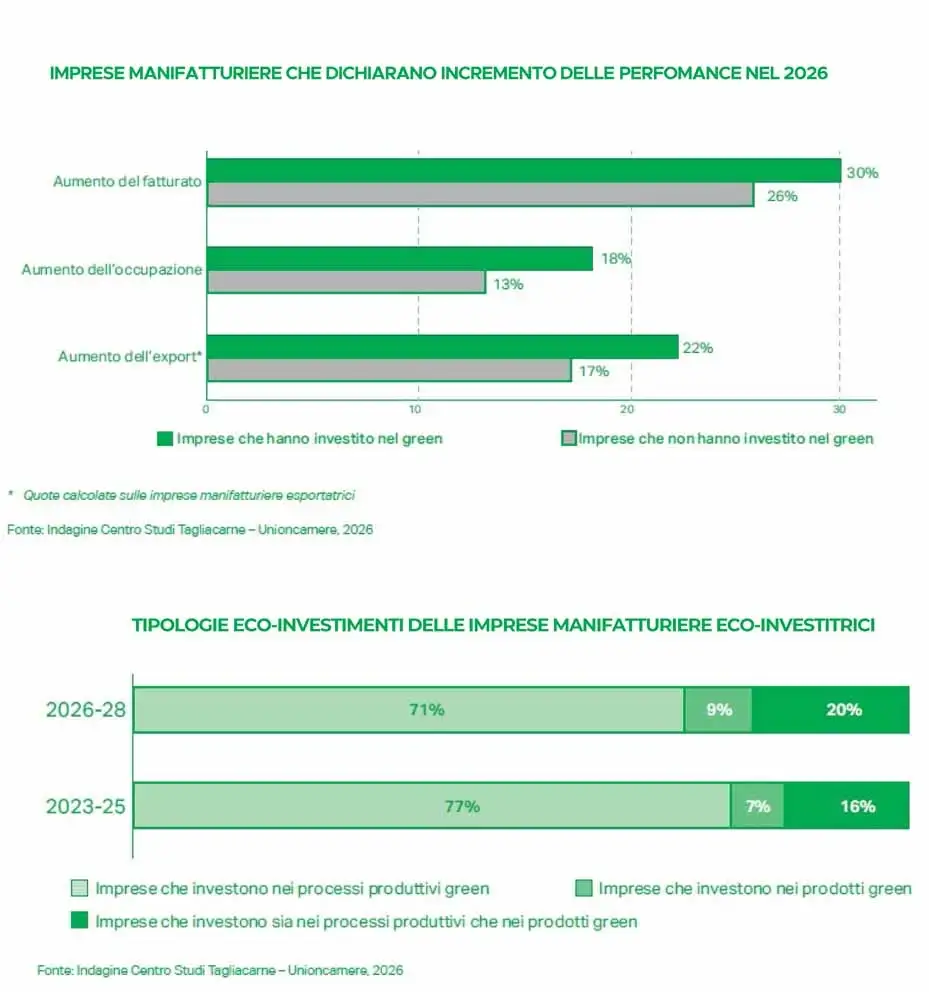
Companies that invest in the green sector appear to have better prospects: among green manufacturing companies 22% expect an increase in exports in 2026, compared with 17% of non-green manufacturers; 30% expect revenue growth, versus 26%, and 18% expect employment growth, versus 13%.
However, the Report highlights the structural fragility of the energy system. In 2025 Italy’s dependency on foreign sources rose from 73.5% to 75.2%, with about 95% of gas imported, although photovoltaic has reached a new record, exceeding 44 terawatt-hours of production.
Authorization difficulties, regulatory instability and infrastructure delays continue to slow a pathway that concerns environment, competitiveness and security together. Added to these delays is also the difficulty of turning available resources into actual investments: in May 2026 about 45% of the €56.8 billion of the PNRR allocated to the ecological transition had been spent.
“There is an Italy – says Ermete Realacci, president of the Symbola Foundation - that can take the lead with Europe at COP31 in Antalya: it makes the green transition an opportunity to strengthen the economy and society. Delays in the development of renewable sources in our country are unacceptable; we are behind Spain and France. The GreenItaly Report shows an acceleration towards a more human-centered economy that focuses on sustainability, innovation, communities and territories. We can give strength to this economy of ours and to this idea of Italy.”
The ranking of Italian green companies
Regarding the provincial ranking of Italian companies that made eco-investments, also in the 2020-2025 period, Rome regains the top spot with 37,810 eco-investing companies; followed by Milan, with 35,020 green companies, Naples (24,270), Turin (19,550) and Bari (18,890). Analyzing instead the incidence of eco-investing companies on the total number of provincial companies, the best performances are recorded in the province of Crotone (47.4%), Enna (46.9%), Pescara (45.6%), Bolzano (45.1%) and Brindisi (45.0%).
Italy leader in the circular economy
In the circular economy Italy, on the other hand, starts from a position of strength. According to Eurostat, in 2024 the recycling rate of municipal and special waste exceeded 90%, ahead of the Netherlands, Spain, France and Germany. Only 3.3% of waste ends up in landfills, compared with 32.4% in Europe, while the material circularity rate is 21.6%, almost double the EU average, stuck at 12.2%. The Italian recycling supply chain contributes to energy savings equal to 16 million toe and to avoiding the emission of 53.4 million tons of CO2. However, this primacy is threatened by the crisis in plastic recycling which in Europe has already wiped out almost one million tons of production capacity in three years.
In Italy the sector is under pressure due to weak demand for recycled materials, higher costs and competition from low-priced virgin raw materials imported from non-EU countries, particularly from China, Southeast Asia and Egypt.
Personnel with specifically green skills
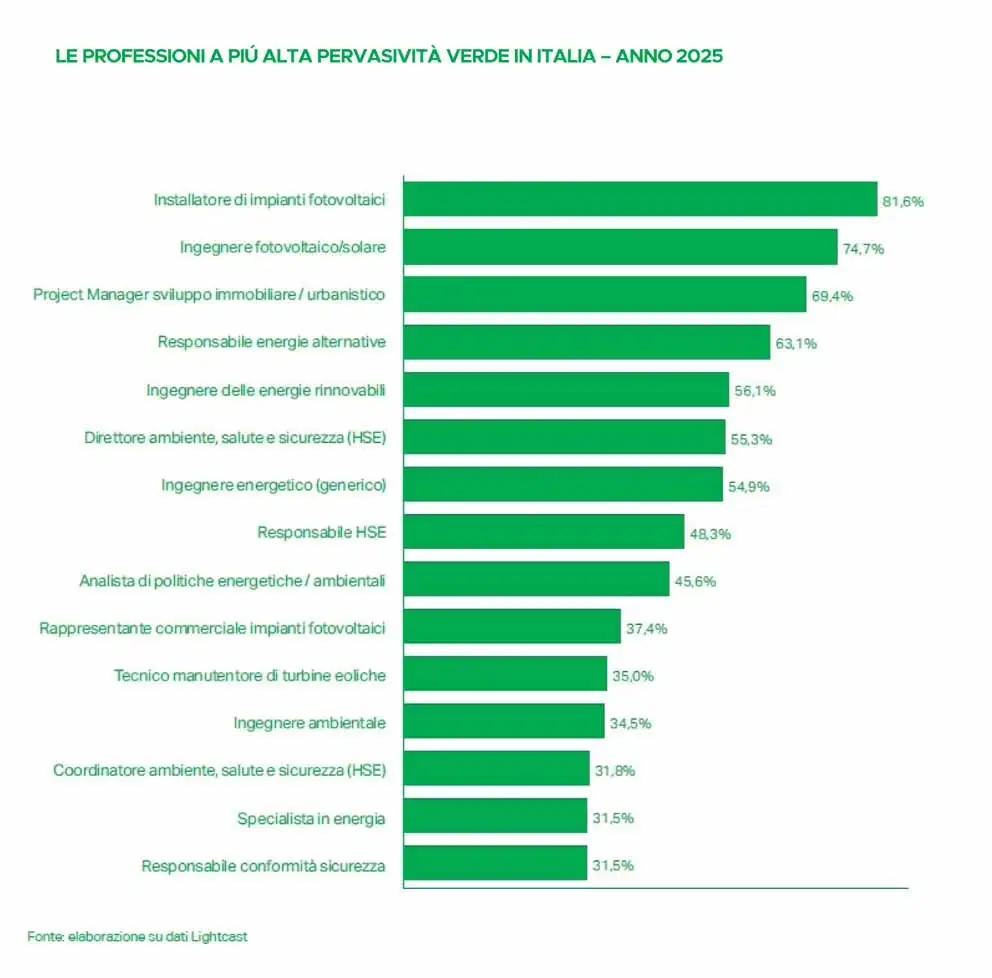
Companies’ eco-investments also show up in the search for personnel with green skills: 79.8% of the total hires planned in 2025 required skills and competencies related to sustainability, while 58.8% required specific figures for the management of products and green technologies.
As Andrea Prete, president of Unioncamere, emphasized, “the green transition has now fully entered companies’ competitive strategies and is profoundly transforming the labor market as well. Specifically green skills are required for almost six out of ten planned hires and, in the coming years, almost 2.4 million workers will need to possess at least one intermediate skill related to energy savings and the reduction of environmental impact. The challenge, therefore, is not only to create new green jobs, but to have the people and the skills necessary to accompany this change.”
The full GreenItaly Report 2026 is available at www.symbola.net and at www.unioncamere.gov.it