
 en
en  Italian
 French
 German
 Spanish
 Portuguese



- 20/04/2026
- Economy, News and Fairs
In an increasingly complex scenario, the design not only confirms itself as a structural component of the European economy, but evolves and strengthens its strategic role, becoming increasingly a key factor of competitiveness, sustainability and cohesion.
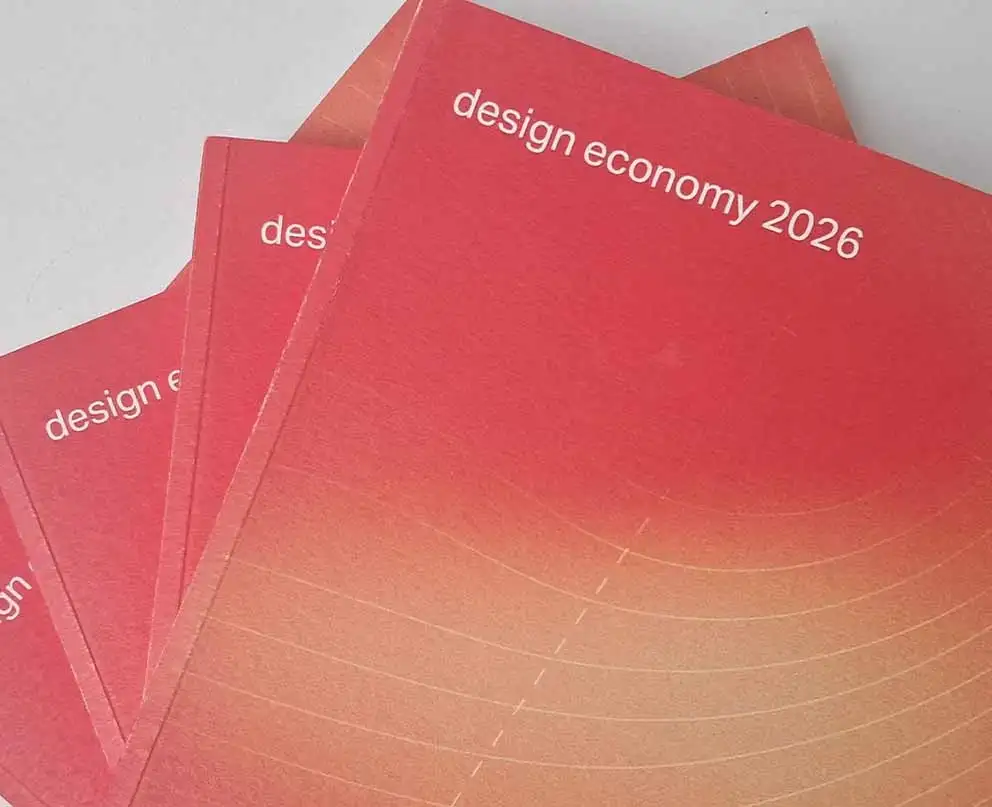
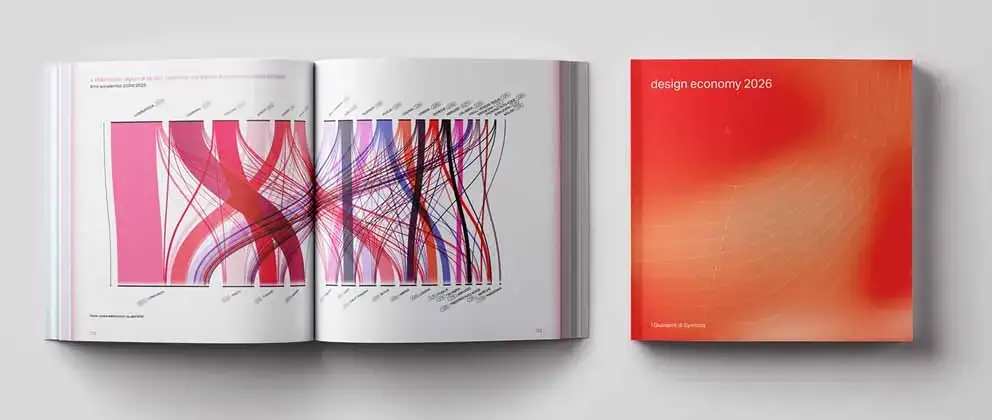
Also this year, on April 16, at the ADI Design Museum in Milan, the Design Economy 2026 report promoted by Fondazione Symbola, Deloitte Private, POLI.design and ADI was presented, with the aim of raising awareness of the value of design for the competitiveness of the national production system.
Italy confirms its leadership in Europe
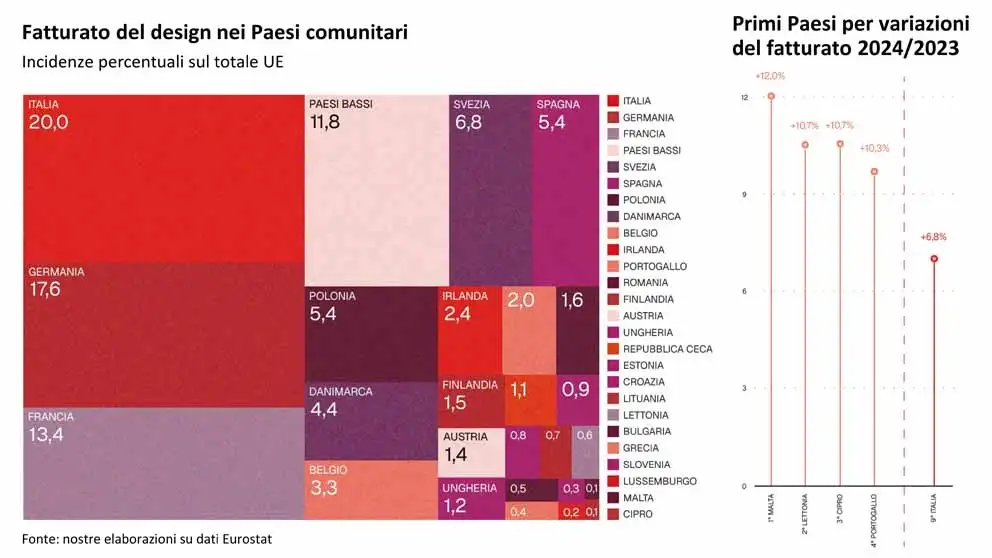
At the European level, the design sector counts about 295 thousand companies, with total revenues of 31 billion euros (+3.2% compared to 2023 and +23.8% over the three-year period) and over 356 thousand employees (+4.8% year-on-year and +16.1% over the three-year period).
Italy confirms its leadership position with 54 thousand operators, equal to 21.5% of the European total, ahead of France (14.9%) and Germany (14.0%). The economic value generated by design is also strongly concentrated in countries with more advanced industrial economies. More than half (51%) of the turnover of the European design industry is in fact concentrated in only three countries: Italy (20.0% of the community wealth produced), Germany (17.6%) and France (13.4%).
Regarding Italy, according to estimates based on ISTAT data for 2024, the figures once again highlight the high concentration of activities related to design in Lombardy, which accounts for 33.4% of the sector’s total added value and 28.7% of total employment. It is followed by the wealth produced by Emilia Romagna (with a share of added value equal to 13.3% of the national total), Veneto (10.9%) and Piedmont (10.3%).
Milan is the undisputed leader, with over 7,300 active companies that alone generate 19% of the wealth produced by the sector at the national level. It is followed by Rome, Turin, Florence, Bologna and Brescia: together, these six provinces concentrate more than one third of Italian design companies.
“The data of the Design Economy 2026 report – said Luciano Galimberti, president of ADI - confirm the solidity and centrality of a sector that not only generates economic value and qualified employment, but contributes decisively to the construction of the identity of Made in Italy in the world. A cultural infrastructure before being an economic one: a critical tool capable of guiding innovation and shaping production processes. The data reflect the image of a mature system, in which Milan acts as a driving node but within an increasingly widespread network. In this context, the challenge is to govern technological and social transformations, reaffirming the role of design as a conscious, responsible and deeply humanistic practice.”
Design education in Italy
Lombardy, and Milan in particular, are also the main hub of Italian design, concentrating 28.7% of university enrolments and 36.5% of AFAM enrolments, in addition to attracting 61.9% of international students. Alongside this concentration, there is significant growth in the Centre and South of the country, with enrolment increases of 18.5% and 19.2% respectively. Overall, in the 2024/2025 academic year Italy has 100 active institutions and 369 degree programs (+5%).
Cabirio Cautela, Board Member of POLI.design (Politecnico di Milano), emphasized that “this edition of the report also confirms the attractive capacity of Lombardy, and of Milan in particular, for Italian and international design students. At the same time, however, significant growth in enrolments is recorded in the Centre and the South, often connected with local and territorial production specializations. It is important to note how these encouraging education figures proceed in parallel with employment data: design remains a healthy sector and there is substantial consistency between the nature of studies and the type of work carried out”.
Design for environmental sustainability
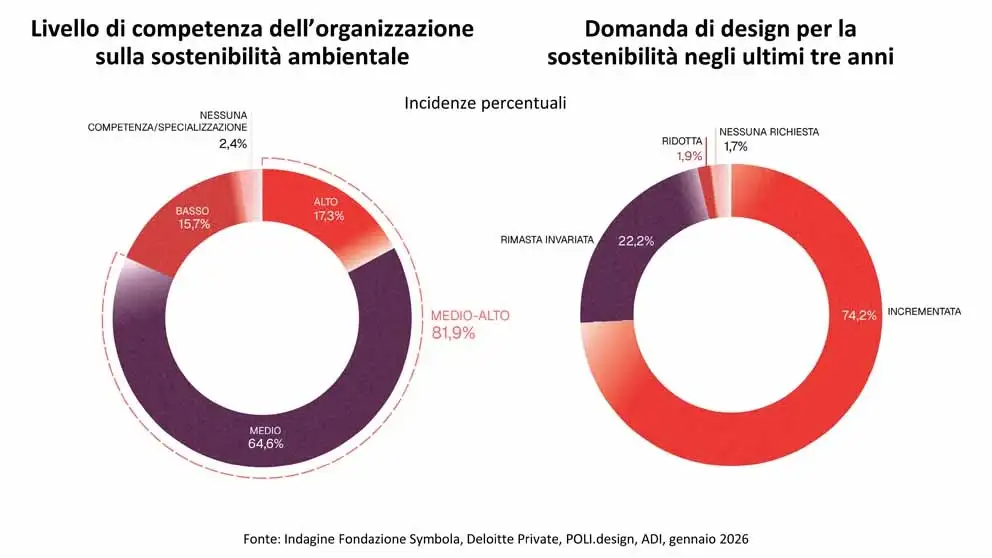
The report explores the role of design in the major challenges of our time: the green transition, the evolution of the technological and digital context and the effects on the designer’s profession. Environmental sustainability emerges as an increasingly central theme in design practices, in response to the increased demand for design for sustainability (reported in the last three years by 74.2% of operators interviewed), thanks to a medium-high level of competence (81.9% of the sample), confirming an ecosystem that is investing in knowledge and tools.
The direct survey also examined levels of competence and knowledge of design practices aimed at improving environmental sustainability. 81.9% of respondents consider their level of competence on the subject to be medium-high, with a peak of 85.5% in the case of designers for whom the indication of a competence level classified as “high” is also higher (18.8% vs 14.6% for organizations).
“Italian leadership in design – said Ermete Realacci, president of Fondazione Symbola - confirms its important role as an immaterial infrastructure of Made in Italy, as demonstrated by the Salone del Mobile in Milan, and is a protagonist in the challenge of sustainability. In the midst of a green and digital transition, design is once again called upon to give shape, meaning and beauty to the future. Design is strategic also to develop a new generation of products that, in the name of beauty, meet the dictates of the circular economy: efficiency, reduced use of materials and energy, recyclability, reusability.”
Generative artificial intelligence in design
The continuous evolution of the technological and digital context has led to focusing attention, through a survey, on generative artificial intelligence (in English “Generative Artificial Intelligence”, or “GenAI”), as a powerful accelerator of transformations in the economy and in the world of design.
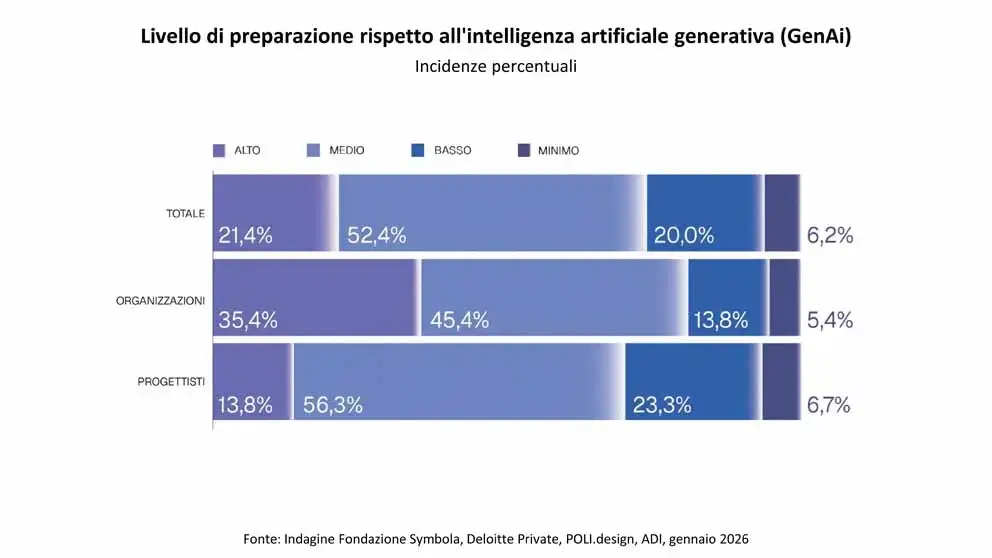
From the report data it emerges that, in general, the level of preparedness regarding GenAI is mainly concentrated at medium values: 52.4% of design operators participating in the survey declare a “medium” level, indicating a wide but not yet fully consolidated diffusion of skills. The “high” level is indicated by 35.4% of organizations versus 13.8% of designers, highlighting a relative advantage of organized structures in terms of technological maturity. For one fifth of respondents the level of preparedness remains “low” while only 6.2% declare minimal preparation.
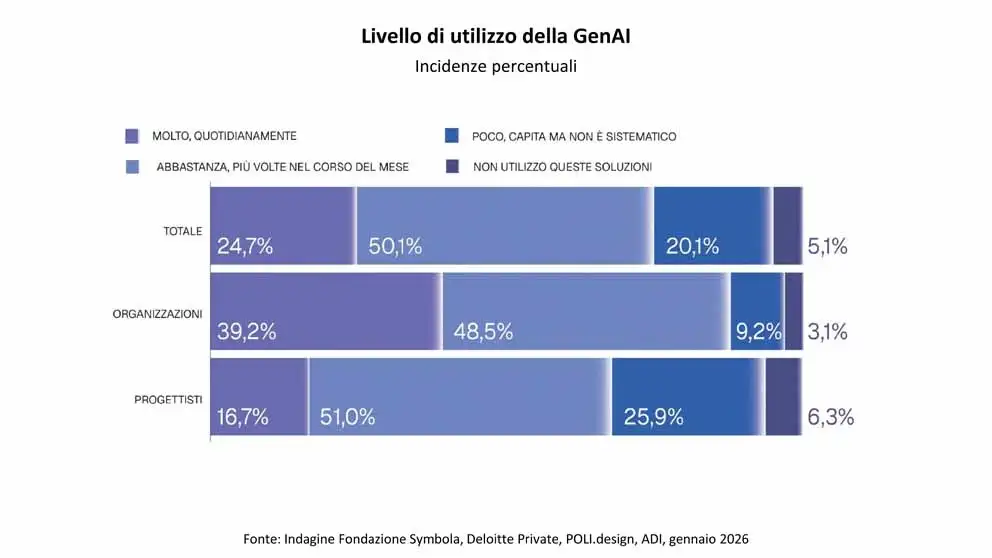
The skills most frequently indicated by the sample as a whole concern “prompt design & strategy” (65%), knowledge of “ethical aspects related to copyright” (52.4%), “visual & content editing” (42.7%) and skills in “sustainable design” (almost 40%), followed at a small distance by “rapid prototyping conducted with hybrid tools” (39%). 94% of designers and organizations have consolidated their generative AI skills in the last two years.
“Digital transformation, and specifically the introduction of the’artificial intelligence – said Ernesto Lanzillo, partner and leader of Deloitte Private in Italy - represents for the entire design sector a priority for development and sustainable growth. To maximize the impact, however, it is essential to redesign processes and operating models based on AI, ensuring that the human contribution is valued and not automated. The right skills and the appropriate use of these solutions by design operators can translate into an acceleration that enhances efficiency, reduces company costs and optimizes resources”.
The Design Economy 2026 report can be downloaded at www.symbola.net